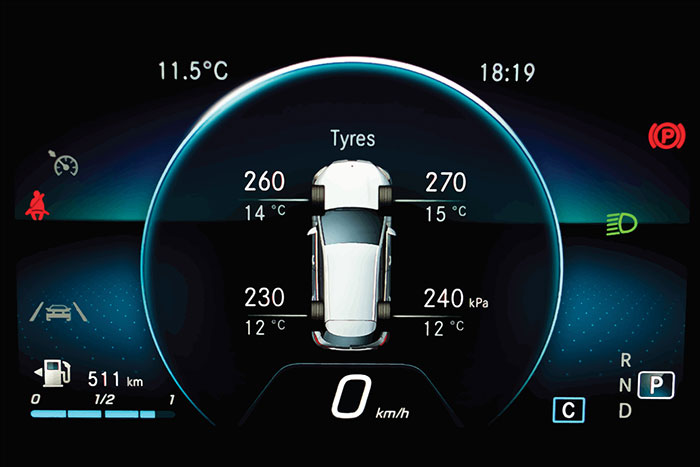
When you’re choosing a tyre pressure monitoring system, it’s easy to focus on the screen and the readings it displays. But the sensors deserve attention too. Where they sit affects how you fit them, adjust tyre pressures and maintain the system over time.
Internal TPMS sensors sit inside the tyre. External TPMS sensors attach to the valve outside the wheel. Both measure pressure directly and send information wirelessly to a compatible receiver. Internal sensors require tyre work for installation or replacement, while external sensors can be accessed without removing the tyre.
Fitting internal and external TPMS sensors
An internal tyre pressure sensor is fitted inside the tyre, commonly as part of the valve assembly. The sensor body sits behind the valve, concealed within the wheel. Some designs use a sensor secured around the wheel instead.
You need a tyre professional to install an internal sensor because fitting requires access inside the tyre. If you’re already replacing your tyres, that can be a convenient time to arrange installation. Once fitted, the sensor stays out of sight and you use the valve to inflate and deflate the tyre as usual.
External tyre pressure sensors screw onto the valves in place of ordinary valve caps. You can fit them without removing the tyres, following the manufacturer’s instructions. This makes them a practical option when you want to add monitoring to a vehicle or caravan you already own.
Safety Dave’s TPMS range uses external sensors. Its standard ST3000 sensors include locking nuts to help secure them to the valves.
Everyday use: checking and adjusting pressure
The difference becomes more noticeable when you need to put air in a tyre.
With an internal sensor, the valve remains accessible. With a conventional external sensor, you remove the sensor to reach the valve, then refit it after adjusting the pressure. If a locking nut is fitted, keep the supplied tool somewhere accessible.
Pass-through sensors provide another option. These let you inflate or deflate the tyre through the sensor without unscrewing it. Safety Dave offers pass-through kits alongside its standard external sensor systems.
Before choosing, check how the sensor will fit around your wheel and valve. Safety Dave notes that the extra weight of its pass-through sensors can cause vibration and wheel scuffing in some installations. The team can advise on suitability if you are unsure.
Access matters when something needs attention
An external sensor is easy to reach. If it needs replacing, you can remove it without arranging tyre work. Many external sensors also have replaceable batteries, so a flat battery does not necessarily mean replacing the whole unit.
Internal sensors are less exposed to outside contact because the sensor body is enclosed within the tyre. However, replacing one requires access inside the tyre. Many have sealed batteries, which means replacing the sensor when its battery reaches the end of its life.
Tell your tyre fitter if internal sensors are installed before having tyres changed. The sensors need to be taken into account during removal and fitting.
If wheels or sensors change positions, follow the system’s instructions so the monitor still identifies the correct tyre. This applies to either type of sensor: the reading is only useful if you know which tyre it belongs to.
Choosing sensors for a caravan
Think about access to the valves on your caravan. Can you reach them comfortably to fit sensors and adjust pressure? Check that any external sensor has enough clearance when fitted.
The complete system also needs suitable signal coverage between the caravan and tow vehicle, with capacity for every tyre you want to monitor. Sensor position alone does not tell you whether a system will suit your towing setup.
Browse Safety Dave’s tyre pressure monitoring systems or speak with the team about your vehicle and caravan.
For an existing system, check compatibility before buying additional or replacement sensors. A sensor that fits the valve is not automatically compatible with the monitor. Safety Dave’s TPMS accessories include model-specific sensors and parts, with setup guidance available in the user guides and instructions.
Internal and external TPMS sensor FAQs
What is the difference between internal and external TPMS sensors?
Internal sensors sit inside the tyre, while external sensors attach to the valve outside the wheel. Both measure pressure directly. Their main practical differences are installation, maintenance access and how you reach the valve to adjust pressure.
How do internal TPMS sensors work?
They measure pressure from inside the tyre and transmit information wirelessly to a compatible receiver. Some also measure temperature. Installing or replacing them requires a tyre professional to access the inside of the tyre.
How do external TPMS sensors work?
They screw onto the tyre valves and measure pressure through them, sending readings wirelessly to a compatible monitor. Safety Dave’s external sensors monitor both pressure and temperature.
Are internal or external TPMS sensors better for caravans?
External sensors are convenient for adding monitoring without tyre removal. Internal sensors keep the sensor body concealed but require professional fitting. Check valve access and sensor clearance, as well as the complete system’s suitability for your caravan.
How long do internal and external TPMS sensors last?
Battery life and sensor life are different. A sealed internal sensor generally needs replacing when its battery runs out. An external sensor with a replaceable battery may remain in use through several battery changes. There is no single lifespan for either type; check the model’s specifications and replace damaged or faulty sensors as required.
Can external TPMS sensors be added or replaced easily?
They can generally be fitted without removing the tyre. The sensor must be compatible with your monitor and assigned to the correct tyre position. Check the system’s sensor capacity and follow its pairing instructions before adding or replacing one.